When a safety surfacing material or system is in contact with water in public spaces as swimming pools, waterparks, or splash parks it is essential to assess that there are no inorganic chemicals that may leach out from the product to the water over the product life, creating potential health problems.

Picture from Drew Hays at Unsplash
Typically, this toxicology test is performed by testing and analysing samples of a water bath containing the flooring product or system for a few days (usually 7,14,21,30 or more).
The level of inorganic chemicals in the water samples must be below the toxic levels defined by environmental Protection agencies or some international standards as the EPA TCLP (Toxicity Characteristic Leaching Procedure), for levels of contaminants that are leached from solid materials.
The TCLP analysis simulates landfill conditions. Over time, water and other liquids percolate through landfills. The percolating liquid often reacts with the solid waste in the landfill and may pose public and environmental health risks because of the contaminants it absorbs. The TCLP analysis determines which of the contaminants identified by the United States Environmental Protection Agency (EPA) are present in the leachate and their concentrations.

Picture from James Balensiefen at Unsplash
The most dangerous inorganic chemicals are Lead, Cadmium and Chromium but the TCLP standard enumerate a list of chemicals as shown on the next picture.
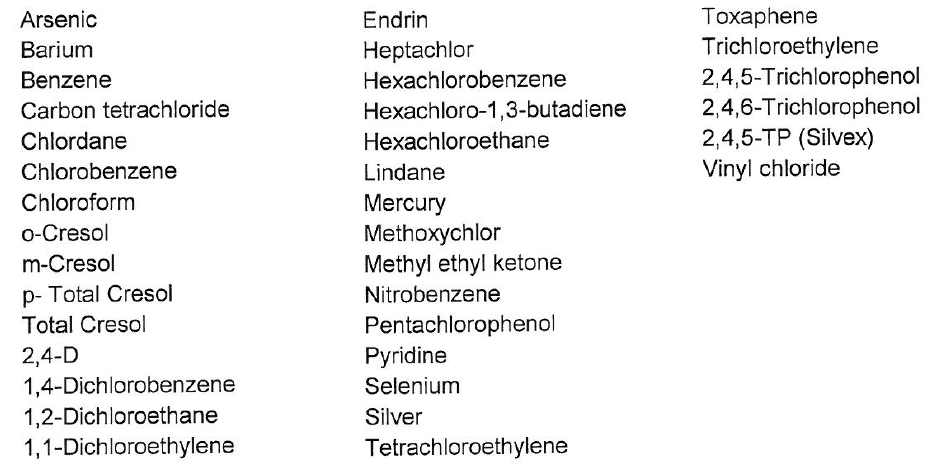
TCLP Standard chemical list
PolySoft successfully completed this test a few years ago on 30 days leaching samples.
But not only water applications must be tested for toxicology and health.
For Safety surfacing on Playgrounds, after the latest REACH2 restrictions on eight polycyclic aromatic hydrocarbons (PAHs)1 in granules and mulches used on playgrounds and in sport applications, the suppliers of these systems must perform a regular test.
This concern for human health resulting from current concentration limits for polycyclic aromatic hydrocarbons (PAHs) is mainly due to the use of End-of-Life Tyre on the absorption layer of a safety surfacing but should be done for any other absorption system used.
Commission Regulation (EU) No 1272/2013 sets that articles shall not be placed on the market for supply to the general public, if any of their rubber or plastic components that come into direct as well as prolonged or short-term repetitive contact with the human skin or the oral cavity, under normal or reasonably foreseeable conditions of use, contain more than 1 mg/kg (0,0001 % by weight of this component) of any of the listed PAHs.
- The 8 PAHs are: Benzo[a]pyrene (BaP), Benzo[e]pyrene (BeP), Benzo[a]anthracene (BaA), Chrysene (CHR), Benzo[b]fluoranthene (BbFA), Benzo[j]fluoranthene (BjFA),Benzo[k]fluoranthene (BkFA), Dibenzo[a,h]anthracene (DBAhA)
- Bureau REACH, National Institute for Public Health, and the Environment (RIVM)
You can get additional information about Polysoft products or get product samples at:
Take care
 Rubberman Blog