One of the quite common impact absorbing surfaces in playgrounds is that using natural loose fill materials such as sand, gravel, bark, woodchips or engineered wood fibres. This type of surfacing provides a natural appearance, has an interesting recreational value, a low initial installation cost and children loves it, especially the little ones.

However, the maintenance of these surfaces while is simple, must be very frequent, which makes it expensive. The material should be frequently raked out to avoid compaction and to ensure minimum CFH thickness in areas such as slides exits, swings and other mobile play equipment fall space where the material usually is displaced ending up with divots and holes under these high-use zones. Very frequently the material must be replaced or replenished after heavy storms that drag the material out. Loose fil materials also present risks of some hidden objects such as broken glass, sharp metals or other dangerous items such as biological remains. It can also be attacked by insects, moss or fungi.
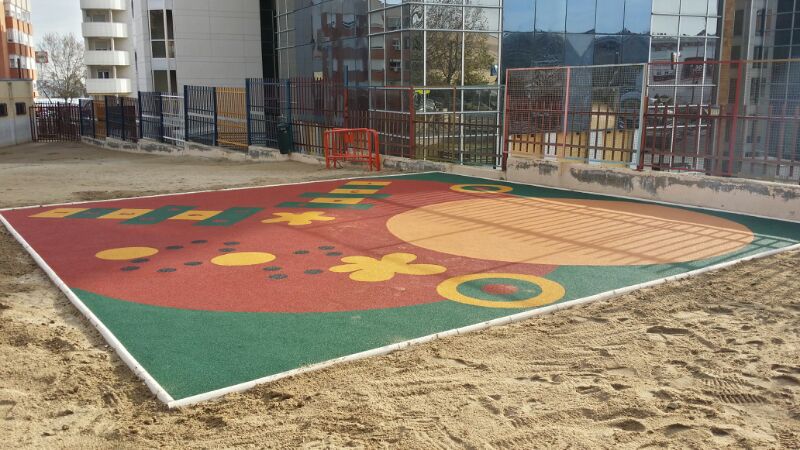
Synthetic solutions such as poured-in-place or wetpour rubber flooring with an EPDM or TPV top layer, have a higher installation cost, but their maintenance is less frequent and simpler. The surface will be good looking and safety remains stable for 7 or more years and you can make coloured designs with a lot of play value and much better accessibility than loose-fill surfacing.
As Playground area managers, I think you should always consider the total cost of the space for his full useful life and not just the initial installation budget. The pay back of an initially higher investment may be well achieved on the first 2 years. Thanks for your time and see you at the playground.
Take care
 Rubberman Blog
Would you recommend epdm or tpv?
LikeLike
I wrote a post about this but in short I prefer EPDM because is easier to smooth than the harder TPV granules, but would select TPV if the level of UV radiation is very high and colours are bright and sensitive to UV as light blue, tile, orange, purple, etc.
LikeLike
Epdm is best, I think. Only I have problems with sbr baselayer, I use rubbercrumb but cannot get any bounce to it. We have no rubber buffings here in Finland, don’t know what the problem is, I do not use pressure when applying. Even if I have about 8 cm thickness.
LikeLike
Hi Anthony
The mix of buffings and rubber granules offers the best absorption capability on cushion layers. An optimum mix I’ve used is 25% buffings and 75% granules 2-8 mm. The kind or rubber granules has also significant influence. Granules coming from tracks tires have a lot more virgin rubber and better absorption. Old tires may be very dry and be harder.
Using the mix of granules and buffings we were able to get the same 3.00 m CFH with 20 mm less thickness, so this would be my recommendation.
In USA with a lot more tire retreading and buffings availability they can do cushion layers using only buffings, but availability of buffings in Europe is limited.
LikeLike