In most municipalities and all countries, investment in playgrounds remains more or less stable, with a certain number of renovations of old facilities and some development or urbanization of new residential spaces.
However, there is one type of installation, the number of which is constantly growing in almost all countries. There are projects everywhere of outdoor fitness areas for adults of all ages and Street workout or Parkour spaces.

Communities are increasingly aware of the risks associated with overweight and obesity and the importance of exercise for improving the health of people of all ages and abilities.
All the leading manufacturers in the playground equipment segment have been adding to their portfolio a set of outdoor fitness equipment, including all types of equipment for cardiovascular exercise, muscular strength exercise, such as sit-up benches, dumbbells, Cross-training, etc.
In this kind of spaces, the flooring is an important factor to take into account for a greater user satisfaction.
The European standard EN 16630 – “Permanently installed outdoor fitness equipment. Safety requirements and test methods”, establishes that equipment that has a height of fall greater than 1000 mm or that implies a forced movement of the user must have fall protection in accordance with the EN-1177 standard, the same used for playgrounds and that this safety surfacing must be properly maintained.
Fall heights of these equipments are generally less than 1000 mm, so the degree of absorbent protection required for playgrounds is not needed, but these areas also require a permeable, safe and comfortable flooring for the different activities that prevent the appearance of injuries, falls, chafing, etc.
Some of these areas are using a sand, natural grass or artificial grass flooring, but for some fitness activities done at the floor level, they are less comfortable and have several other drawbacks compared to rubber flooring solutions.
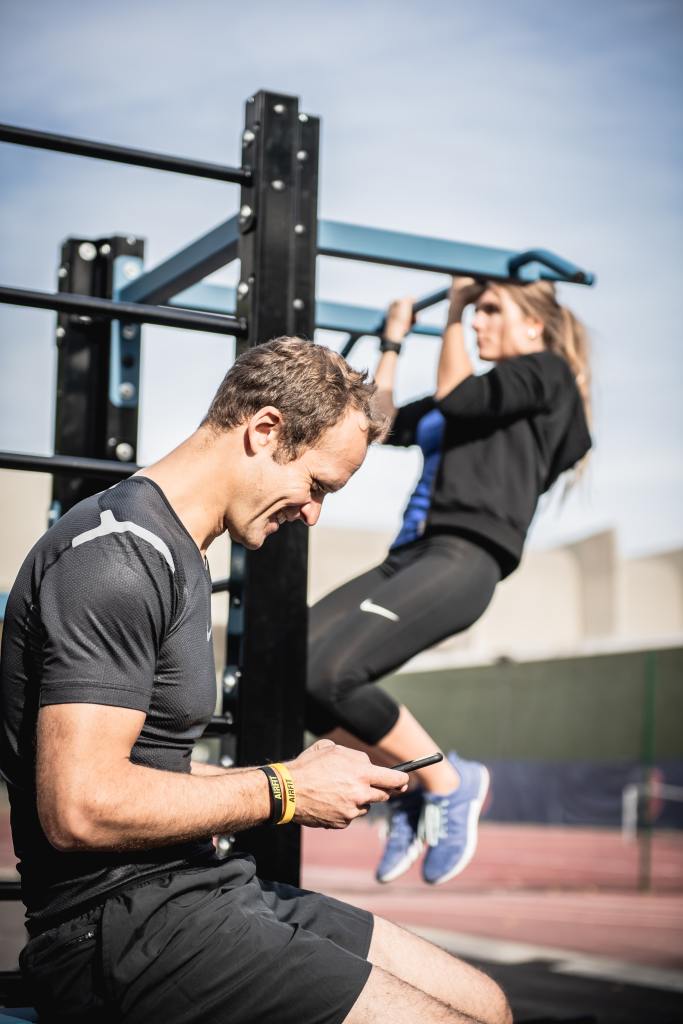
Rubber flooring is the most common choice for most of these projects. First of all, it prevents slips and falls and absorbs the impact of these and other elements such as weights. It is permeable with very rapid water infiltration, which prevents the formation of puddles and allows the area to be used immediately after rainfall. It is resistant to the external environment and allows the use of different colors and to make markings and graphics for the different floor exercises.
For these outdoor areas, the most effective solution is a single layer of about 20mm EPDM, TPV or coated SBR, over concrete or asphalt sub-base or alternatively a double layer with a 25mm SBR cushion layer and a 15mm top layer, up to a total of 40 mm on sub-bases of compacted stone.
I personally prefer the comfort of granulated solutions over the mulch for these outdoor fitness applications, but bonded rubber mulch can also be a reasonable alternative for low budget projects.

Cork may also be a good organic alternative if you do not need to add marks or graphics for floor exercises, but it is usually a more expensive option.
The recycled rubber materials are the ideal solution to optimize the budget and have most of it, in fitness equipment. In this sense, products such as the Playtop Nike-Grind granules, obtained from the recycling of end-of-life sports shoes, are a magnificent example of circular economy and sustainability.
This rubber flooring allow lines and graphics to be marked for the different exercises and have good protection against environmental effects, with a lifespan of several years.
Certain exercise locations may be subject to extensive wear, so the quality of the materials in terms of tensile properties must be good and the thickness of the top layer in the case of double layer should not be less than 15 mm to ensure a reasonable duration of the area.
Take care and do some exercise
 Rubberman Blog