Short answer: NO. You can leave the reading if you only want direct testimonials.
One of the latest tourism trips I did with my wife before COVID was to Lisbon and several other nice cities around this part of Portugal. We bought several amazing gifts made from cork. Portugal is one of the first producers of Cork and Oak Trees and they really master the artisan production of the most varied objects on cork.
Oak Tree, absorbs carbon dioxide and provides cleaner air and according to Amorim it is estimated that the cork oak forest can sequester up to 73 tons of CO2 per each ton of cork produced.
Some companies that I have known for years, within the segment of safety flooring for playgrounds and sports facilities, have started in the last 1 or 2 years to market, promote and install cork for playground flooring and artificial grass cushion layer or infill.

In a previous post in this blog, I explained that I had no practical experience on the use of cork and hoped to be able to start some research or pilot projects within the CONICA innovation team to learn, test, evaluate and measure its characteristics, advantages and drawbacks in a direct and practical way. I have been always interested on natural products so I also showed interest in this product for our business.
Unfortunately, despite CONICA’s interest, it has not been possible for reasons beyond our control.
Many of my installer friends that also know that I love environmentally friendly solutions frequently ask me my opinion about the use of cork in these applications and I must admit that I do not have direct experience. I only have the references and comments that I received from other fellow installers and companies that work with the product from some time ago.
If I have the opportunity to get direct experience with cork in the future, I will tell you about it, but for the moment I can only collect some feedback or indirect references here.
I am always open to technical debate on issues in our activity, so if you do not agree or have more experience in this matter, do not hesitate to leave me your comments and opinions. The debate usually enriches the knowledge.
Infill applications
In my opinion, cork is the best existing alternative of infill to avoid synthetic solutions and the polluting consequences due to the presence of microplastics, PAH and other chemicals or heavy metals. As a 100% natural, recyclable and renewable product, it is free of toxins and fully respects the environment.

Its main drawback is that due to its extremely low bulk density it could easily spread in the presence of wind and rain storms. Recently, mixtures of cork with other denser organic products such as olive pits have been presented, which can reduce the problem to some extent, keeping the same good functional conditions as infill.
For the application of shock pad or elastic layers for artificial turf systems there are also options in the market for mixes of cork and rubber from recycled tires that create a good performance system.
In my opinion infill projects are currently the best application segment for cork granules.
Playgrounds Safety Surfacing
Its main advantages compared to traditional synthetic granules are the absence of odours and potential allergy phenomena and its lower surface temperature in sunny areas that allows the surface to be used barefoot. Its low bulk density allows a lower weight of the flooring for those cases that may have load weight restrictions as for example on a rooftop.
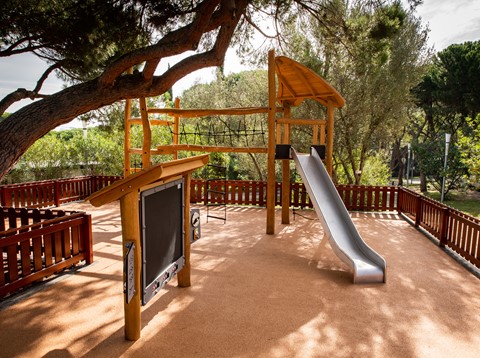
As in the previous section, the low bulk density of the cork granules can also be a drawback and makes the mixing process a bit more difficult in existing forced mixers. The blades of the mixers flip the granules in the air and the mixing time must somewhat be extended to ensure sufficient impregnation of the granules by the binder. A rethinking of mixers for cork may be needed to overcome this inconvenience. Solutions could be found whether on the blades shape or on the type of forced movements to reduce mixing time and ensure proper glue impregnation.
The need to use primers as acetone for the sub-base and polyurethane binders for gluing, make the cork lose its 100% natural organic condition to fall under microplastic category, thus losing its fundamental natural advantage. Predictably, in the mid-term, bio-polyurethane solutions and primers with a 100% natural composition will appear on the market, what would eliminate this inconvenience.
The porosity of the cork granule causes the binder to leak or permeate its interior, to some extent, increasing binder consumption and reducing its impact absorbing capacity. This can lead to difficulties in reaching the theoretical critical fall heights. This would be the consequence of infiltration by porosity.
The variability of colours and designs of wetpour rubber based on EPDM, TPV or encapsulated SBR, one of the main advantages of wetpour safety surfacing, is not possible with cork in the top layer. As a natural product it is available on a single colour with no options for graphics or shapes that add play value.
My questions:
There are several questions I have and maybe the experts already have the answers.
These are some of my questions:
- How does the cork respond mid-term to possible attacks by insects, fungi, moss, etc.?
- Over the years, can its visual appearance be maintained with regular cleaning maintenance or is there an irreversible darkening of the original cork colour?
- Is the shock absorption capacity maintained or reduced over time or as a function of the level of area use and how elastic is cork itself mid-term?
- How does cork react over the years to the high humidity and rainfall or frost typical of the climate in certain geographical areas?
- What resources are being used to keep cork plantations running in the main geographical sources of cork production as Portugal and South Korea and is it really as sustainable as claimed?
- Why is it a lot more expensive than rubber?
After two decades working in Research and Development in other quite different segments of activity, I am still a professional profile always interested in experimenting, learning about, improving, evaluating and implementing new products, as well as asking myself many questions. Maybe some of my readers already have the answers. Feel free to share them here, because the aim of this blog is to help wetpour installers.
Take care
 Rubberman Blog