During the last 10 years of dedication to the playground business and more specifically on safety surfacing, I have had the opportunity to see projects made by my own crews or subcontractors and a lot of others carried out by our competitors.

A lot of them were beautiful, almost works of art with an amazing skilled job, but some had quality defects shortly after installation.
Problems are usually visible in the top wearing layer but very often have the origin on the sub-base or the base SBR layer, either due to lack of stability, compaction, presence of contaminants in the sub-base, or excessive textile or metallic contaminants in the SBR granules or inadequate percentage, viscosity or type of binder in the base layer, incorrect priming of the sub-base, incorrect drainage solutions, etc.
The main generic causes of quality problems, ordered from highest to lowest frequency are:
- Incorrect installation procedure, defective or without adequate control
- Binder unsuitable for the environmental conditions of installation
- Inadequate or unstable sub-base or improperly resolved drainage or priming
- Low quality of the main materials used (granules, polyurethane binder, primer, smoothing agent)

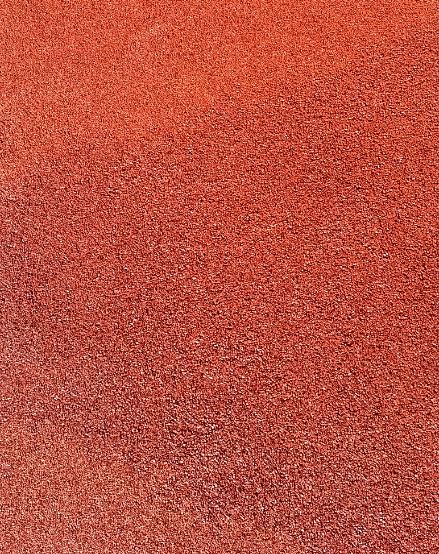

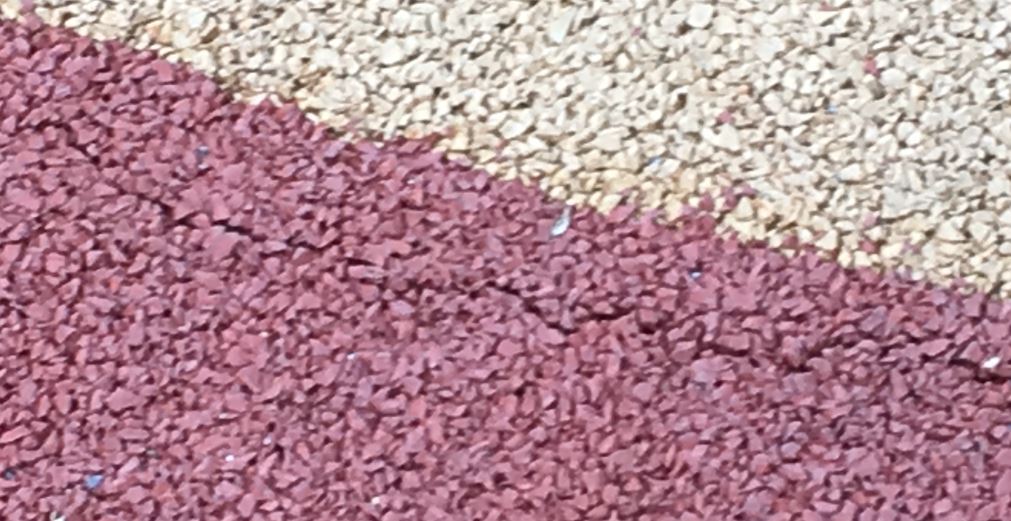


The list of things that can go wrong is long as you can notice on the pictures around this post and it is not always easy to identify the main cause of the problem. Very often is the combination of more than one factor. The list below is not ordered by frequency or any other criteria It is only the ones I have seen as I have been remembering:
- Whitening of rubber granules due to migration of the filer or sub-base contamination
- Foaming on some areas
- Granules crumbling, excessive wear or abrasion
- Cracks on top layer
- Different visual aspect on the same blend of colours
- Joint separations and openings with edges or within colours or shapes
- Insufficient critical fall height achieved
- Stripes, shadows, halo effect or different visual aspect on an area of same colour
- Colour change (yellowing effect)
- Colour differences on the same colour (batches inconsistency)
- Clothes staining from the granules
- Ponds or drainage defects
- Granules melting
- Delamination of top or full top and base layer





To find the cause or causes of these problems, an “on-site” investigation is needed and for that there is a series of essential information that the installer must record in all their works, such as:
- Temperature and humidity at least on each day of installation or at various times of the day if there are significant variations.
- Manufacturing batch and product reference for all materials used, including cleaning agent, primers, etc.
- Photos of the sub-base before starting and of the work in different phases and once it is finished.
- Record of climatic incidents, mixing percentages, mixing times or any other relevant data.
Without these data, it will be difficult for the researcher to find the causes and for your supplier to give you good technical support and warranty, and as an installer these data are part of the evidence of your good process quality control.
ALWAYS REGISTER CAREFULLY AND KEEP THIS DATA FROM YOUR JOBS FOR AT LEAST 5 YEARS
And before you say it, yes, in some cases the problems may come not from an installer or material fault, but from the operator owner or users as for example: a lack or defective maintenance, bad use or vandalism.
This is something the research can help to identify. For that, again, all this previous quality data registers are helpful.
In a next post I will collect all my recommendations to be a GOOD wet pour installer and this repeated request of registering data will be of course in the list.

Take care
 Rubberman Blog