
Sorry in advance for adapting the most famous expression at Hamlet tragedy.
It was the only way I found to start a maybe long post that is around an old discussion I have been hearing and reading during the last close to 20 years.
Rubber recycled from tires has been used in playground surfacing and infill sport fields as a “green” alternative to other uses of end of life tires but pretty soon some people asked if it was sustainable and healthy to use recycled tires in a product for children.
Let’s collect and review a pill of history from the references listed at the end of this post.
People have been using rubber for hundreds of years. When Christopher Columbus arrived in the new world, he found natives using balls made of natural rubber. Rubber is produced naturally in the sap of a rubber tree. It was not long before rubber and rubber trees were exported to Europe, where people found many uses for the durable tree extract.
In 1832, American Charles Goodyear discovered that adding sulphur to rubber changed the material’s properties. This patented process is called vulcanization. Vulcanized rubber holds a permanent shape.
The first rubber tire was created by Scottish inventor John Boyd Dunlop in 1887. It was used on a bicycle for Dunlop’s son. The tire gained attention after bicycles using Dunlop’s tires began winning bicycle races. The mass production of personal automobiles happened at almost the same time, with the Ford Model T arriving in 1908.
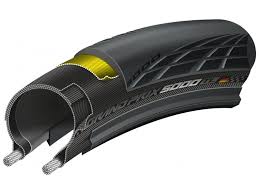
As more and more people began driving cars, more and more used tires were, quite literally, piling up. Tire disposal is difficult because tires do not decompose. They do not melt. They cannot be easily reshaped. Since tires need to be replaced after a certain number of miles, scrap tires became a growing problem.
In the 1960s, a German named Berleburger Schaumstoffewerke improved on the process for recycling rubber grinding the rubber into smaller pieces. Schaumstoffewerke used the recycled rubber to manufacture materials used in athletic complexes, such as running tracks and floors in gymnasiums. He also manufactured floor tiles to be used in children’s playgrounds.
Although several playgrounds started to use this recycled rubber solutions the scrap tire problem continued and worsened. Disposed tires were stockpiled worldwide in landfills and private dumps. The tires collected water and created a breeding ground for disease-causing mosquitoes. They also presented a fire hazard and several fires have occurred at different places.
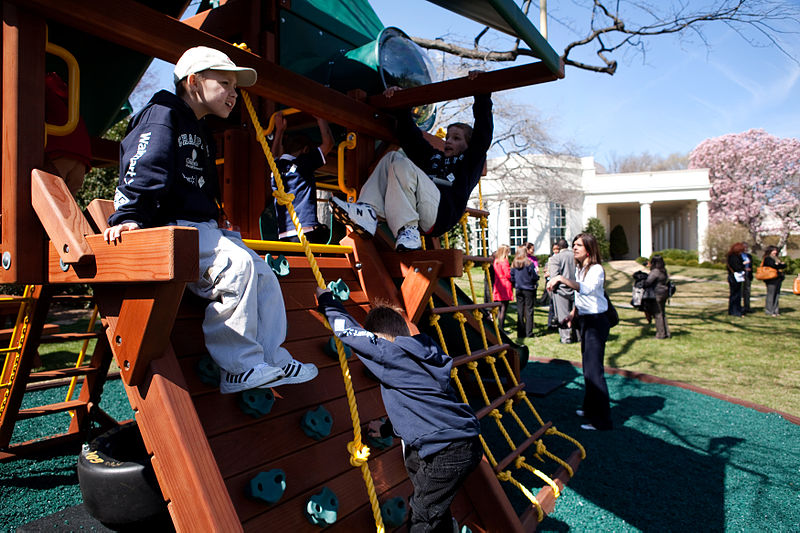
When Barack Obama began his first term in 2009, the Obamas installed a playground for their daughters at The White House. The first official White House playground featured recycled scrap tire rubber mulch manufactured in New Jersey. The mulch was chosen for its safety properties. It met all guidelines published by The International Play Equipment Manufacturers Association (IPEMA) and the Americans with Disabilities Act (ADA).
When questions About Safety Start
Early concerns about the safety of rubber tire mulch focused on the composition of the product. Tires are not constructed entirely of vulcanized rubber. They also contain other minerals, steel wires and textile bands to support the tire’s shape. Soon modern recycled tire techniques were able to clean more than 99% of textile and steel wires.
There were also questions about the volatile organic chemicals (VOCs) contained in tire rubber. The health risks of VOCs include effects on the respiratory system, allergies, and immune systems of children. A report on playground safety conducted in California and published in 2003 found that recycled tire rubber includes at least seven carcinogens, chemicals capable of causing cancer.
In October of 2014, NBC News published a story questioning the safety of artificial turf. After several Washington State soccer players developed similar cancers, an investigation was launched into the safety of artificial soccer fields. The turf investigated used crumbs of recycled scrap tires as fill to add shock-absorption to the fields.
NBC examined available studies from the EPA and others. They interviewed scientists and industry professionals. The story concluded the researchers were “unable to find any agreement over whether crumb turf had ill effects on young athletes, or even whether the product had been sufficiently tested.”
A follow up story in December of 2014 focused specifically on the use of rubber tire scraps on playgrounds. The public was concerned that children were playing in the same material that had not been conclusively found safe for use in artificial turf. Parents complained that the mulch left black marks on their children’s clothing and skin. Loose fill rubber mulch was only used in USA but not in Europe where it is always used in bounded form using a PU binder.
In 2016, the Board of Education in North Shore Long Island, NY, voted unanimously to remove and replace the rubber mulch in several elementary school playgrounds. Several other school districts also replaced the rubber tire mulch at their playgrounds in 2017 and some other efforts to remove tire mulch from playgrounds were conducted by Environment and Human Health, Inc (EHHI).
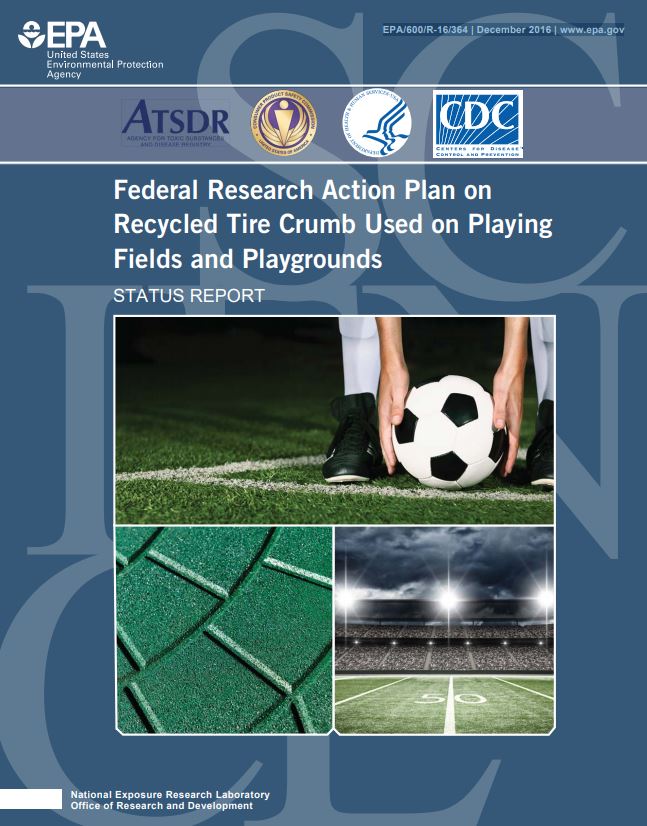
That year, an inter-agency study had been announced by the EPA, Centres for Disease Control and Prevention (CDC), and the U.S. Consumer Product Safety Commission (CPSC). The effort is called the Federal Research Action Plan on Recycled Tire Crumb Used on Playing Fields and Playgrounds. The government research examined possible exposure to the chemicals contained in rubber tire crumbs. A summary of the Tire Crumb Rubber Characterization Study was expected to be released later in 2019.
The repeated delays on releasing the study, along with disclosures revealing the limitations of the study’s designs, have increased the rumours and concerns around the safety of these products instead of filling the knowledge gaps on the body of science once and for all.
More or less consensual conclusions
Although artificial turf infill and Poured-in-place (PIP) surfaces both utilize crumb rubber, the crumb rubber in playgrounds surfaces is in a bound state and confined in the base layer of the finished product. Therefore, the crumb rubber used in Playground surfaces is not considered to present the same level of risk as unbound crumb rubber in artificial turf fields (OEHHA, 2007). Overall, the literature search did not identify any health risks associated with the crumb rubber or other additives of PIP surface systems when in its bound state and confined beneath the topping layer because when cured the crumb rubber base layer, where the PAHs are found, is separated from the users by this topping layer.
Chemical hazards were identified for individual components of the material, but not the product as a whole. Ingredients, such as SAS and Carbon Black are expected to be inextricably bound in the product and under normal conditions of use are not expected to present a health risk from inhalation or other routes of exposure (WHO, 2010).
In addition, the chemicals used to produce the PU binding agents are considered inert once the product has cured and are a minimal health risk to users.
US, Canada and European Union have adopted legislation limiting PAH content in the production of tires from 2016, therefore, PAHs in the crumb rubber of PIP surfaces will be reduced in the future as older tires are phased out. Additionally, a study that measured PAH levels of crumb rubber surfaces reported that exposure to aromatic PAHs from these surfaces is low within the range of ambient air background levels (Menichini et al., 2011).
During 2017 and 2018, a series of additional fact-based, scientific findings have been released adding to the more than 90 studies, peer-reviewed academic analyses and government reports already demonstrating the safety of these products.
Relevant bodies such as RIVM, the Dutch equivalent of US Environmental Protection Agency, and the European Chemicals Agency (ECHA) conducted their own scientific tests of recycled rubber and arrived at similar conclusions and recommendations. The two organizations referred to any potential risks posed by recycled rubber as “virtually negligible,” and “a very low level of concern,” respectively.
More than 41 sources in a peer-reviewed journal, Sports Medicine, stated the science does not support the hypothesis that recycled rubber is unsafe. By providing more playing surfaces and thereby promoting healthier lifestyles, recycled rubber actually lessens the likelihood of cancer.
The chairman of the FIFA Medical Committee wrote: “The effect of SBR rubber are as negligible as the effect of ingesting grilled foods or exposure to tire wear on roads in everyday life”.
Good, that means that in your next BBQ or doing your running workout along a road you will get more exposure to PAH and Carbon Black than our children in a Playground but there are, of course, a few things we should do:
- Inspection of playgrounds to monitor the overall condition and maintenance of PIP surfaces to prevent public exposure to the crumb rubber base layer.
- Proper PIP surface maintenance by the owner/operator (as per manufacturer’s instructions) should also be encouraged so that worn or damaged areas in the topping layer are appropriately repaired.
References:
- EPA/600/R-16/364 | December 2016 | www.epa.gov
- Fact Sheet – Health and Safety Considerations Associated with the Use of Recycled Waste Tires for Playground Surfacing – Kansas Department of Health & Environment – 6/26/2013
- A review of the potential risks associated with chemicals present in poured-in-place rubber surfacing Courtney Janes*, Ludmilla Rodriguez*, Chris Kelly*, Theron White*, and Chad Beegan* *Healthy Physical Environments, Alberta Health Services – DOI: 10.5864/d2018-001 – March 2018.
- The Comprehensive History of Rubber Tire Mulch – PLAY NEWS WIRE – April 9-2019
- The science is in — EPA, end the debate on turf safety – The Hill – June 21-2017
 Rubberman Blog