Landscape Architects and Playground Designers are usually defining their safety surfacing design by using a colour code from one of the existing standards.

The most frequently used Colour Standard is the Classic RAL System, that was created for defining colours for paint and coatings. This Standard is used today in architecture, construction and all industry.
The EPDM manufacturers also use this RAL Code frequently on their data sheets and brochures to help customers and designers to identify the colour options among the portfolio.
Matching accurately the colour of a granule to the one on the colour table usually printed on paper or plastic is not easy. The colours on the brochures or on the RAL colour deck may be affected by dust or shifts due to the base material used or the printing process of brochures or even on the official RAL deck.
This matching is always an approximation . Comparing colours from different base material with different surface finishing properties make this task dependent of the light conditions, the surface brightness and also the contrasting background.

The binder used for gluing the granules will also modify in some way their initial colour even before considering any potential UV effects.
The EPDM manufacturers have slightly different RAL codes, this is not weird having in mind that a single Red colour may have a lot of tone variants, with more than 40 official RAL codes, and the same happens for all the rest of basic colours.
To produce a granule on an specific RAL code, requested by an architect or playground designer, although feasible, is a task that requires: testing the mix of several pigments and proportions, trial and error, time and when finally it seems you have achieved the right matching, some more time will be needed to perform an accelerated UV test that should be always done to make sure that the stability of the new designed colour granule is correct. To pay back this costly process, a minimum order quantity will reasonably be required by the manufacturer.
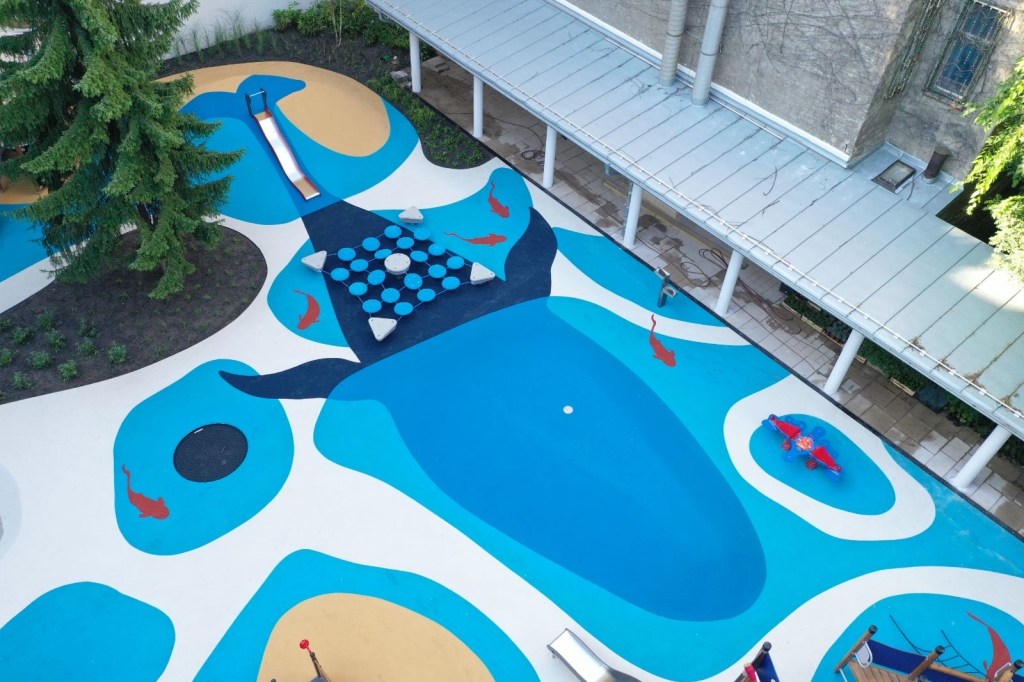
As an Architect or Designer maybe you can accept a RAL 3017 instead of the RAL 3020 that you had in mind in exchange of several months delay on the project or a minimum order quantity that clearly exceeds the material needed for your project.
Take care
 Rubberman Blog